
THE FADING LIGHT
THE FADING LIGHT
When Adaeze was born, her mother called her “My Sunshine.”
She had a laugh that could brighten even the darkest room, a child so curious she could dismantle a toy car just to see what made it move.
Teachers loved her, “brilliant, outspoken, full of promise,” they’d say.
But that was before the smoke.
It began innocently, as these things often do. Adaeze had gained admission to university, far from home.
Freedom tasted sweet, and new friends made everything brighter.
One evening, as laughter and music filled the hostel corridor, a friend offered her a tiny roll of brownish-green leaves.
“It’s just weed,” he said. “Everyone does it. Helps you think deeper.”
She hesitated, but curiosity won.
The first drag made her cough. The second made her giggle. The third… made her float. For the first time, Adaeze said she “felt alive.”
Weeks turned into months.
Assignments piled up, lectures became optional, and home calls became shorter. Her once-brilliant eyes grew distant.
She stopped sketching, the thing she loved most.
Her mother noticed the change in her voice during phone calls, slurred, detached, strangely cold.
When Adaeze finally returned home for the holidays, she was nit the sunshine her mother remembered. Her clothes hung loosely. Her laughter sounded forced.
She spent nights pacing the corridor, murmuring to herself, sometimes giggling at nothing.
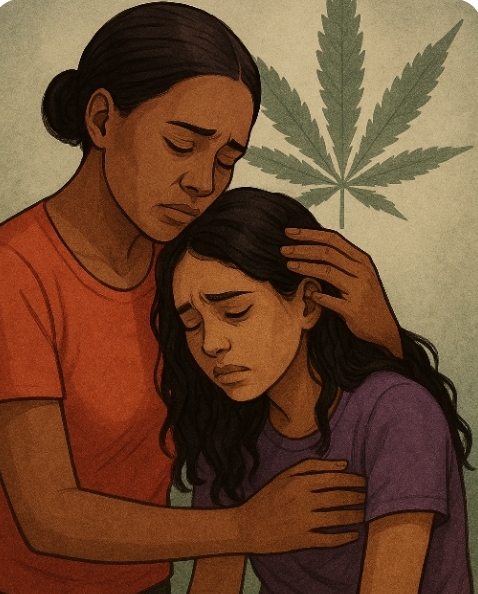
Her mother cried silently, clutching her daughter’s old artbook, the one filled with portraits of hope and colour.
Then one night, the knock came.
A frantic voice at the door, Adaeze’s roommate.
“Aunty, please, come quickly! Ada slumped!”
The world blurred. The drive to the hospital felt endless. Adaeze’s body lay cold, her pulse faint. The doctor’s words came slowly, like stones sinking in water:
“She had a psychotic episode, possibly drug-induced. We’ll do our best.”
Days passed. Adaeze survived, but not unchanged. Her once-sharp mind now wandered. She would stare into space for hours, whispering fragments of forgotten dreams.
Her mother never left her side, bathing her, feeding her, singing old lullabies in the hope that somewhere deep inside, her sunshine still listened.
One evening, Adaeze looked up and asked softly,
“Mummy… do you think I’ll ever draw again?”
Her mother’s voice broke, but she smiled.
“Yes, my child. One day. But first, we must heal.”
Today, that mother volunteers with Balm for the Bruised Foundation, telling her daughter’s story, not for sympathy, but for salvation.
She tells young people that marijuana is not “just weed.” It can steal your laughter, dim your light, and leave your family clutching memories instead of dreams.
She speaks with trembling strength:
“If only Ada knew the cost of that first puff, maybe, just maybe, my sunshine wouldn’t have faded.”
Balm for the Bruised Foundation: Soothing your pain.
Healing minds. Restoring hope. Saving futures.
About author

You might also like
BFBF Begins Empowerment Of The Girl Child Through Sensitisation
Balm for the Bruised Foundation, BFBF, has commenced what it called empowerment of the girl child to prepare them for the future, to know their rights, have the ability to

BROKEN ROADS, BROKEN LIVES: HOW DRUG ABUSE FUELS ROAD ACCIDENTS IN NIGERIA
BROKEN ROADS, BROKEN LIVES: HOW DRUG ABUSE FUELS ROAD ACCIDENTS IN NIGERIA On a cool evening in Abuja, Chioma clutched her mother’s hand tightly as they crossed the busy junction


Balm For The Bruised Foundation Represented As Organisations Collaborate To Ensure Gender Inclusion In Nigeria
Balm For The Bruised Foundation Represented As Organisations Collaborate To Ensure Gender Inclusion In Nigeria Adaora Ezeaka Abuja The gender inclusion journey started as early as 1975 when
0 Comments
No Comments Yet!
You can be first to comment this post!